I have decided to do a quick study on what the impact of social media has been on the recent Xenophobia issue. I believe if we know how it impacts on a situation we can make use of that knowledge to actually make a difference a whole lot quicker.
Stii was kind enough to provide me with a dump of all blog posts that were tagged with 'Xenophobia'. Though there is currently no way to link twitter usernames to the blog posts. Therefore i have uploaded the spreadsheet to Google docs, anyone can edit it as long as you have an account. Please add your twitter username to all your own blog posts or any others that you may recognize. the rest of the fields are optional. If you cannot edit the spreadsheet send me your blog url and i will capture it:
Twitter: ismail
---------------------
Invite to collaborate on the document:
I've shared a document with you called "xenophobia_blogs_google":
Capture Directly onto the sheet (Use this to see if your blog post is included on the list):
http://spreadsheets.google.com/ccc?key=pTD3FWar02UT7peKMx1YXSg
Capture in the Form (Use this, it's the easiest option)
http://spreadsheets.google.com/viewform?key=pTD3FWar02USt49zxHtknJQ&email=true
It's not an attachment -- it's stored online at Google Docs. To open this document, just click the link above.
Doing an analysis on effects of social media / twitter / blogs in a
crisis situation, I need to link up the blog posts to twitter
usernames. If you have blogged about the Xenophobia please claim it and
add your name under the column 'Twitter username'
------------
I would also appreciate if you could pass this on to any bloggers you know that have blogged about the situation.
Wednesday, 28 May 2008
Investigating Twitter & Blogs impact on the Xenophobia issue
Friday, 23 May 2008
Technology for change - Repost
The blogosphere has been up in arms over the recent xenophobia attacks. It is extremely sad and depressing to see our country in a state like this. We can debate and debate but all that will matter is taking action. We have to ask ourselves how can we use technology to make a difference?
Stii suggested we create a non profit organisation, in which people donate which is a great idea but i believe with the brilliant people and the range of skills we have we can do a whole lot more.
Read write web recently ran a great article on how to use social networking and media for social change and Muhammed Karim has an interesting post on using web 2.0 to fight hate. With technology the costs of coordination is drastically reduced. As a collective group lets think about ways on how we can use technology to make a difference. For example, How can we use technology to educate people? To stimulate entrepreneurship and self owned business? To reduce crime?
Internationally there are sites like kiva who offer micro-lending to entrepreneurs. Sites like wikicrimes or ushadi which are Google maps mashups that show you the hotspots. There are more then 3 different events being held monthly in South Africa for business networking, surely we can set aside time to make a difference and brainstorm some ideas?
To get this ball rolling i have created a page on the South African Twitter Wiki, add your name to the list and any ideas you may have.
Let's solve real problems.
** Update: Rafiq and the guys from quirk e-marketing have created a site similar to usahadi which can be found at http://www.unitedforafrica.co.za/
** This has been reposted here as i initially posted to techleader but it has not been published as yet.
Thursday, 22 May 2008
Ten days...
Well, its been over a week since i last posted for now posts will be sporadic here, though you can find me blogging at techleader or StartupAfrica, And for the lighter side of things my totally random tumble log.
View blog reactionsSaturday, 10 May 2008
Twitter Business Model, Why google is scared
Read Write web recently ran a post on monetizing twitter with a business model using ads. The post was good, and i believe it makes sense However i believe they missed one key point. Twitter can be used from your mobile phone.
When Google launched image based mobile ads. i briefly covered what google mobile ads were missing and why context (what is the person doing?) is important. Twitter offers that context, add a location to that and your pretty much have killer mobile advertising. Its contextual to what the person is doing and localized.
No one out there can offer advertising for mobile as relevant as that right now , not even Google. This is the reason Google was quick to snap up Jaiku, they realise that twitter is actually a threat to their mobile advertising business. Some people may have been confused about why i sent this tweet, it seems a far fetched but Twitter is actually a threat to Google mobile ads business, which according to reports could be a larger market then internet advertising.
Tuesday, 6 May 2008
IPhone available soon in South Africa, Need cheap replicas for Africa
Fin24 reported this morning that the IPhone will be available in South Africa. Often i have conversations like this with people regarding the phone
Friend: So how is that phone?
Ismail: The best phone i have ever used
Friend: But you cant MMS / It doesn't have 3G / You cant forward SMS
Ismail: yes, but it's still the best phone i ever had
Now, please note i have never been an Apple Fan having said that, it is the best phone i have used thus far. Iphone is impacting on mobile internet usage like how blackberry did on mobile email.
Recently a guy ran the girl friend/wife/significant other usability test on Ubuntu Linux, basically to see how easy it is for a non tech savvy user to complete basic functions. The IPhone passes these with flying colours. All my previous phones (HTC, Nokia) failed dismally with functions other then calls and SMS.
I believe this is important. Lets take a look at how access to communications can stimulate economic growth and raise the quality of living.
In a study (PDF) by Harvard economist Robert Jensen he reported that when mobile phones were launched in kerala in 1997, Fisherman used the phones to call local markets while still at sea. This in turned helped raise profits by 8%, lowering consumer prices by 4% and reduced catch wastage from 6.5% to practically nothing.
This is just with access to voice communications, now imagine what easy access to knowledge and information (The Internet) would do?
Mobile phones have been available for a decade in most parts of Africa and there are more people with mobile phones then computers. Africa only has about 4% Internet penetration compared to 29% mobile penetration. Also remember that a number of people using mobile phones in Africa may never have had access to computers or the internet growing up. The environment in Africa may be best for mobile internet. Though mobile internet has been stifled by high data prices, cost of handsets and complicated interfaces.
So what does this mean?
I do not expect the IPhone to actually make a difference since Apple caters for the higher end of the market. Though Nokia has been been working in Africa and if they can develop something similar just as intuitive with easy access to the internet at a much lower price they would win back a fan. With data prices lowering this would allow masses of people access to the large body of knowledge found on the internet. Good times ahead!
Monday, 5 May 2008
Free Album from Nine inch nails, The future of music
Today Trent Reznor announced on the official Nine Inch Nails website that he would be giving his new album album "The Slip", free of charge under a creative commons license.
From their web site:
"We encourage you to remix it, share it with your friends, post it on your blog, play it on your podcast, give it to strangers, etc."
Now, this is not the first move like this, prince has been selling directly to the public for years. Last year we saw radiohead offering their album on the internet and you got to choose how much you wanted to pay. Now both these moves make sense, and are very significant.
Are we we seeing the end of the record labels as we know them?
I believe so. Take a look at the costs that go into producing an album, only a small fraction of that goes to the artist.

With the internet most of these costs are zero, therefore artists can offer them at a fraction of the normal price or even free as NIN have. The future will be the democratization of music, previously artists had to make the right contacts and hope they would be noticed and get 'signed'. Now that wont matter anymore. The time from when music is actually recorded to when it will be released will be much quicker, and here is the best part:
We get to choose who are the best artists, and which artists get played on the radio and not the record labels.
P.S Lets hope the other band that was 'subtly' referenced in this post follows suit
P.P.S if you figured out the band, give yourself a pat on the back
P.P.P.S Posts to this blog will be a bit sporadic as i am working on another project
Friday, 25 April 2008
What is Google mobile ads missing?
Google launched mobile image ads a few days back, and i have been asking myself will they work? Techcrunch also ran a poll and unsurprisingly a large portion of people selected that they would not follow a mobile ad. However Google does point out that with increasing usage of mobile internet & larger screen sizes this market will soon take off. This report from cellular news says it will be a 10 Billion market by 2010. Thats quite possible. Though is the ad placement technology currently ready for mobile internet?
Google has taken their current Ad system, and have adapted it for the mobile screen. When you consider how different the use of your mobile is compared to the use of a desktop computer this is not the best solution. For example:
You are most likely accessing the internet on your mobile phone when you are out & about, at the mall, on the beach, in your car, waiting in line at the bank, the point being you are currently doing something else. You are doing some sort of ACTIVITY and your mobile phone is just there to add value.
When you sit at your desktop/laptop you are most likely sitting down with the specific purpose of achieving something such as surfing the net, typing out a document, researching some topic,, catching up with social networks/email.
There in lies the fundamental difference in how we access the internet on PC/LAPTOP vs a mobile device. Just for a moment, analyse the psychology of this and the motivations behind it.
... got it?
With the traditional method of accessing the net we make the decision to set away time to spend at the computer and surf the internet, we are doing nothing else but sitting at the computer.
With mobile devices we are making a decision to DO something else. The mobile phone and by extension the internet is there purely to serve a purpose which is to add value at that specific time, in that particular context. It may be used to do all of the things we do on traditional desktops/laptops but it usually means we are also doing something else.
This is why mobile ads may not prove as lucrative with enough click through as your normal internet ads. The time you have when you are accessing a mobile device is of HIGHER value, then when you are sitting at your desktop surfing the net. Therefore you are less likely to click on a link for an AD. The AD has to be much more relevant than it is currently.
Yes, Google ads are currently relevant using the query, possibly the location of your IP and other factors but with mobile ads there needs to be another level of relevance and that is CONTEXT.
What is the user doing at that point in time? What is he actually looking for? Where is he?
And that's what's currently missing from Google mobile ads, Relevance + Context. I have ideas on how to achieve that but we can save that for another day.
Thursday, 24 April 2008
The reason behind Apple Iphone shortages & the business model
There have been numerous reports of iphone shortages in Apple stores in the US. Check out news24 for the latest article on this or this article which speculated the shortages were due the launch of a 3G version. The main reason seems to be unexpected demand from the grey market (Imported via improper channels) and a large portion of these phones are displayed in stores here in Dubai.

Suddenly everyone seems to have an Iphone, everyone seems to be walking around with those signature white buds in their ears.
This though does come with its problems other then Apple stores with out stock. Take into consideration that most people are buying the phone on the grey market knowing the following:
- There is no support or warranty
- The battery cannot be changed and has to be sent back to Apple, without it being bought via the official channels this could possibly mean the phone cannot be used if the battery is faulty in the phone or recharge cycles being used up
- You have to 'unlock' / 'hack' the software everytime a new update is released
- Uncertainty if a particular update will brick your phone
Yet people are still buying the phone. Apple has created such a brilliant phone that even people who dont own Macs, ipods and are not Apple fanatics are jumping at the chance to pick one up. Even with no advertising or marketing.
When you consider the business model used in the US / UK, exclusivity and the operator paying Apple for each new customer, you realise this model may not work everywhere. Lets take a look at some of the reasons:
- AT&T pays Apple for customer acquisition. Now consider a case like the UAE, where mobile penetration is in excess of 110% (People have more then one phone) there is no reason to use the phone to drive customer acquisition. Also in most other parts of the world there are a few operators with significant market shares who do not need exclusivity with a particular handset to drive market share like AT&T did.
- Operators tend to subsididze mobile phones, even offering them practically at no charge. With the additional costs, the model of subsidizing the handset fully by operators is unlikely.
- With the demand for grey market iphones, operators are receiving the benefit of increased data usage without any payout to Apple. They could also capitalize on this market by offering a flat fee on data usage without ever signing up for a deal with Apple.
- The mobile market has been plagued for years with unlocking, operators subsidize handsets the customer signs up for the contract, unlocks the phone and stays on his original network. Also to date there has never been phone that was not successfully unlocked within a short space of time. The battle against the unlockers is a loosing one.
- Every manufacturer out there is planning an Iphone Killer, and if the handset is just as good without the Apple business model who do you think operators will choose?
All of this makes a deal with Apple very unattractive, hence my statement in this post about Apple needing a more attractive business model. They need to rethink their business model in the rest of the world. Especially if they want to achieve a healthy market share in the mobile market and knock the likes of Nokia out.
How?
They could drop the entire business model of the operator paying them back for each acquisition as this does not make sense for an operator who already dominates the market. They concentrate on offering consumer services such as ITunes (Music,Applications & Conent). They should also integrate the phone more with the network, as they did with visual voicemail which is unusable in other parts of the world, an example would be location based services and content delivery.
With the release of the 3G iphone, they could offer Youtube / ITunes over 3G, making the deal more attractive and with this a revenue sharing agreement based on data usage of iphone users. Operators would also benefit as they could finally start seeing some ROI on their 3G roll out & licensing costs.
Now.... that would be a winning formula and when ill be investing in Apple stock.
Wednesday, 23 April 2008
Dont cry wolf Techcrunch, Mainstream media is not dead!
Being a regular reader of techcrunch i naturally followed them via twitter and this afternoon news broke on the techcrunch twitter account about an apparent security issue with twitter. See the screen shot below of my twitter timeline. The tweet pointed to a post on Techcrunch.
Links to the original twitter updates: 1,2,3
Initially, i took it as the truth but twitter does not have a mass delete fuction(Why dont they?) and it did not seem to be affecting me. So i did not bother with message deletion.
Now an hour later, i get this in my timeline. Take note of the time difference.
This whole saga is extremely interesting. First Twitter was dragged through coals and then Grouptweet for being a security risk. Now i know in the world of marketing the customer is NEVER wrong, no matter what they do but lets take a look at the facts.
It's a fact that neither Grouptweet nor twitter have a security issue. Grouptweet has a pretty simple principal, it takes any messages directed at a specific twitter account and retwits(no pun intended) it. Since some users have public timelines it uses direct messages to ensure privacy for the group.
Twitterholics which first covered grouptweet said
"The service at GroupTweet.com lets you send out private tweets to a group of people at once. To use GroupTweet, create a Twitter account for your group and register it at GroupTweet."
The website also clearly states "Create a twitter account for your group" & "Tell all members to follow the GROUP account"
As you can see the instructions are pretty clear. Now, would you not expect the writer for a high ranking technology publisher to understand this simple concept?
Anyone who has been involved in any kind of technology industry realises that majority of the time issues are related to the user not understanding the application or the UI not being intuitive enough for the user. Anyone that has been involved in this field for a while would ask the following question anytime someone comes to them with a problem:
"Did you do anything different today?" / "Install any software?"
In this case it should have been:
"Were you playing with any new twitter Apps?"
While also verifying with other users if they were facing something similar, this far we have only had a report of one other user. Though someone posted in the comments of the article that the same thing had happened to them a week ago but they managed to figure it out.
Just these simple questions & common sense would have avoided this whole debacle. Also note in the twitter timeline all updates by 3rd party apps clearly state which application initiated the update. It takes only a few seconds to review this.
I see this kind of thing regularly from new hires, in an effort to impress they will discover a 'new case', but i ask them questions as it could be someones reputation/job on the line. Eventually they learn to ask the questions themselves. The motivation is recognition and not discovery.
In a rush to get the breaking story Michael Arrington did not bother to ask any questions, he wrote first asked questions later. Also take a look at the time the screenshot was taken on the original article. The article most likely started soon after the tweet went up without any questions asked.
Now they may argue thats the whole point of a blog, its the opinions that matter and not the questions but when you look at the article there were no opinions. It was a ' Breaking NEWS' story, nothing more. They could also say that it was due to the article that the issue was figured out but that would be wrong as well. (See above for why it would have been a simple to figure out)
I believe the more popular and the higher your readership the HIGHER your responsibility should be to ask questions. As the repercussions are worse. Now would you not want to to feel safe in the knowledge that the high ranking technology publishing companies you rely on for news such as techcrunch ask those questions before they publish?
You astute readers may have noticed i avoided using the word blog, as the site no longer qualifies as a blog. It's a publishing company pure and simple and even though they have been highly critical of mainstream media. The only difference between traditional media is a sensational headline gets more newspapers of the stands on the web it means more traffic. As long as the 'supposed' mainstream 'blogs' dont ask simple questions and follow some standard journalistic practices mainstream media are here to stay.
Therein lies the the paradox, when you 'Monetize' it stops becoming about expressing yourself or making a change it's about the traffic and revenue or taking down CNET(See techcrunch for that article).
I hope we have all learned a lesson, cry wolf too many times and people start to doubt your authenticity. View blog reactions

Tuesday, 22 April 2008
Analysing SA Blogs, Where are the black readers/bloggers?
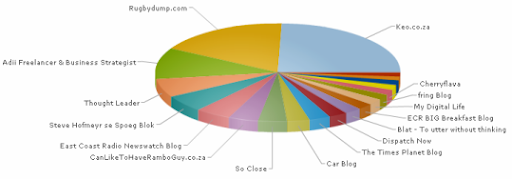
Amatomu a round up of South African blogs has just passed their one year anniversary and the stats are quite interesting to note. If you happen to follow the SA blogosphere you can be forgiven for thinking majority of South African are huge rugby fans.
Take a look at the screen shot of the most popular blogs in the last 30 days which are publicly available here.
The top two sites(Rugbydump & Keo) which account for roughly 30% of the traffic focus mostly on rugby. There is nothing entirely wrong with that as sites like amatomu are 'democratic' and the public choose the best with the number of visits but the statistics become more interesting when you delve deeper to what they actually mean.
I do not believe anyone could claim that rugby is the most watched or the most popular sport amongst South Africans yet these blogs are the most popular, this further proves that the blogosphere is not actually an accurate representation of South Africans.
This points out that black bloggers and readers are strangely lacking. This was covered by Khanya when the site launched. A year later and the picture has not changed. Khanya ends his blog with
"Perhaps there is a need for some affirmative action here."
This is just plain silly.
It however does point out that Black South Africans are not blogging nearly enough nor are they surfing as much. I haven't seen any statistics on internet usage or access to PC's of black South Africans but i am willing to bet that the imbalance would be represented there as well.
Instead of calling for affirmative action, we should concentrate on education and getting people access to computers & the internet.
As with my previous post i will end with:
Stay tuned for some practical steps to initiate change. View blog reactions


View tumble log